
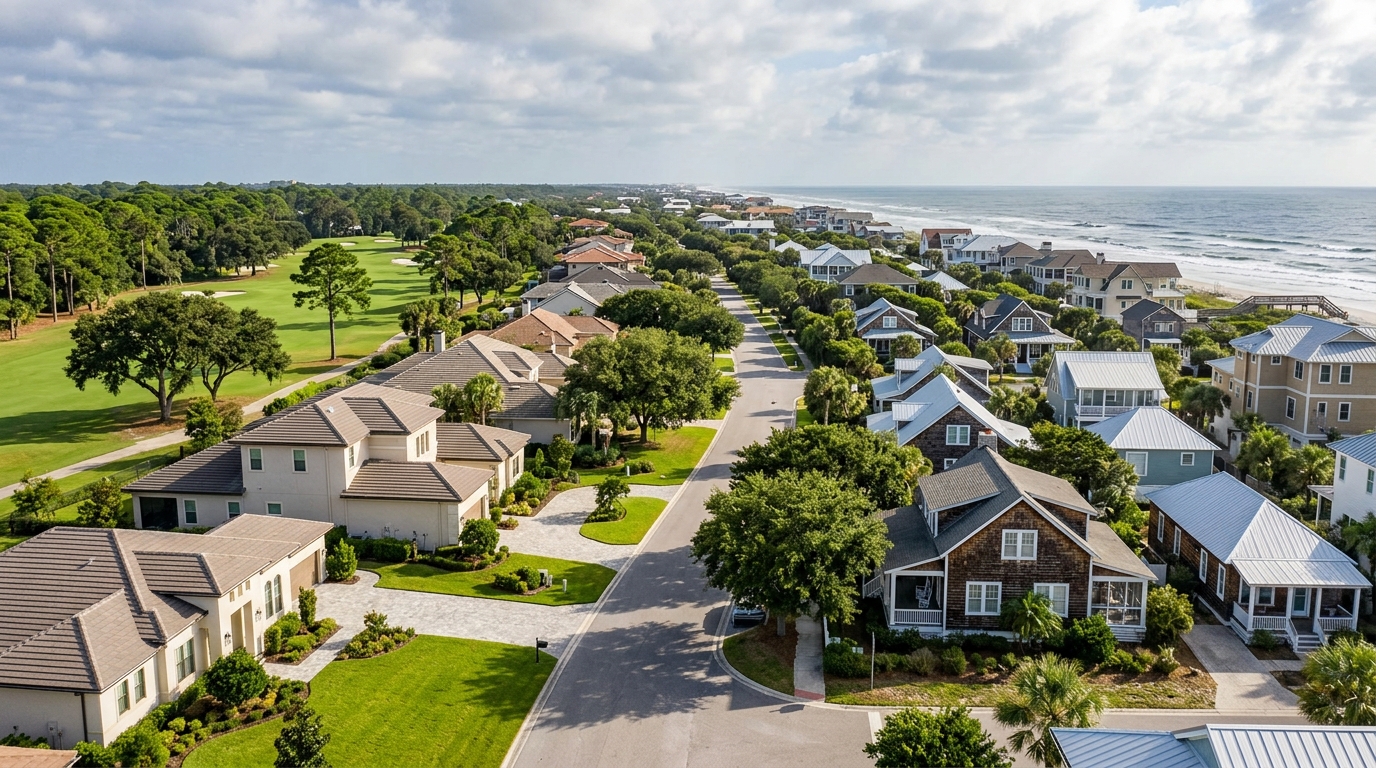
Atlantic Beach Country Club and Beaches Town Center represent two very different housing choices sitting less than a mile and a half apart in the same corner of Duval County. Beaches Town Center is not a subdivision at all. It is a walkable commercial and residential district straddling the Atlantic Beach and Neptune Beach city line, where the housing stock ranges from 1920s cedar-shake cottages to contemporary custom rebuilds. Choosing between them comes down to a few concrete trade-offs: newer construction and club amenities versus architectural character and walk-to-the-sand convenience, a fixed 178-home pool versus a heterogeneous district inventory, and bundled golf-club carrying costs versus HOA exposure that swings widely by property type. Here is how the two compare so you can match the right profile to your priorities.
If you value newer construction, golf and club access, and water or fairway views inside one community, this is the profile that delivers it.
Which Atlantic Beach Country Club tradeoffs matter most to buyers?
Atlantic Beach Country Club is the only golf community among the Jacksonville Beaches, a residential enclave of 178 home sites built around a full 18-hole course, roughly four blocks from the Atlantic Ocean. The clubhouse and amenities opened in 2016.
Most homes run between about 2,000 and 4,500 square feet, and many feature large kitchens, first-floor primary suites, pools, covered lanais, and golf course, preserve, or water views. That is the core appeal: unlike the older beach neighborhoods where renovation is part of the deal, the draw here is walking into a finished, modern home.
You can dig deeper into homes for sale inside Atlantic Beach Country Club to see how the current stock lines up.
Which housing features define the Beaches Town Center district?
Beaches Town Center is a pedestrian district at 200 First Street, Neptune Beach, and it functions as the boundary between Atlantic Beach to the north and Neptune Beach to the south, twelve miles east of downtown Jacksonville. Its housing is not one product. The walkable streets around the core hold everything from 1930s "Old Florida" cottages and bungalows to townhomes, condos, duplexes, custom rebuilds, and live/work configurations. That eclectic mix is the point: you can find a cedar-shake bungalow from the 1920s a few blocks from a contemporary new build finished in 2025 or 2026.
Walkability is the defining feature. Lot lines here are smaller than in a golf community, which trades yard space for a denser, neighborly feel.
The district is also actively changing. A retail, entertainment, and hotel center called Saltwater Row is planned for a former Kmart site near Atlantic Boulevard and Third Street in Neptune Beach, with a first phase of 30,000 square feet of ground-floor retail beneath a 44-room boutique hotel, and a second phase adding an approximately 150-room hotel [news4jax (accessed Jul 26, 2026)]. Paid parking is also coming to the Atlantic Beach side of the district to ease congestion, worth factoring in if you plan to live at the edge of the walkable core. For a fuller look at the range, see real estate options around Beaches Town Center.
One structural detail matters here. Because the district straddles two municipalities, a given home may fall under either the City of Atlantic Beach or the City of Neptune Beach, each with its own code. The Neptune Beach Code of Ordinances is codified through Ordinance No. 2025-20, enacted January 5, 2026 [Municode, accessed Jul 26, 2026]. Buildings near the core can also carry Central Business District zoning, which permits a single dwelling within the same building as a commercial use, allowing an owner-occupant live/work setup.
How do carrying costs, amenities, and walkability compare between the two?
The clearest difference in monthly cost is structural. Across the wider Atlantic Beach market, HOA fees range from roughly $30 to over $5,200 per month depending on the product, a spread that reflects everything from bare single-family HOAs to full-service condo associations. In the Beaches Town Center district, that same range applies, so a modest cottage and a full-service oceanfront condo sit at opposite ends of the same scale.
| Dimension | Atlantic Beach Country Club | Beaches Town Center district |
|---|---|---|
| Housing stock | 178 newer homes, roughly 2,000 to 4,500 sq ft | Mixed: 1930s cottages to modern rebuilds, condos, duplexes, live/work |
| Amenities | Private club: 18-hole course, seven Har-Tru courts, junior Olympic pool, clubhouse | Walk-to dining, shops, nightlife, and public beach access |
| Walkability | Compact internal streets; drive-plus-short-walk to town | Pedestrian-first core; car often unnecessary on weekends |
| Beach proximity | About four blocks from the Atlantic Ocean | At the sand |
On amenities, the two are close to opposites. On walkability, the district wins outright, while the golf community trades some walk-to-town convenience for its course and club layout. You can compare these profiles side by side in more depth through this Beaches Town Center versus Atlantic Beach Country Club breakdown.
Which housing choice fits which buyer?
Atlantic Beach Country Club fits the buyer who wants golf and club access, newer construction, and water or fairway views packaged in one community close to the beach. If you would rather not manage a renovation and value having a fitness center, tennis, and a pool a short drive from the sand, the finite 178-home pool is built for exactly that. The trade-offs to accept are limited architectural variety and the constraints that come with an HOA and club structure. Because turnover in a compact community is modest, patience on timing matters more here than in the broader market.
The Beaches Town Center district fits the buyer who prioritizes walking to the ocean, restaurants, and shops, and who wants architectural character or a flexible product type. It is the right choice if you want a 1920s bungalow, an income-generating duplex, or a live/work building near the core, and if you accept that older stock often carries renovation cost and older-systems risk. The upside is that you buy into character and a walkable lifestyle rather than a uniform floor plan.
Both areas share the same tight, seller-favorable market posture as of mid-2026, with buyers holding modest negotiating room due to limited supply [Momentum Realty, June 23, 2026]. If you are still weighing the wider beaches, the difference between the two municipalities themselves is worth reading in how Atlantic Beach and Neptune Beach compare.
Confirm the club costs directly before you buy in Atlantic Beach Country Club. Current HOA dues and club initiation and membership fees are not reliably published and change over time, so the practical step is to contact the club membership office and request the current dues schedule and initiation figure in writing. Understanding how membership costs factor into total homeownership expense is essential before you assume a monthly number.
In the Beaches Town Center district, verify which city a home sits in and how it is zoned. Because the district straddles Atlantic Beach and Neptune Beach, a property's permitting, code, and any live/work rights depend on its municipality and zoning. For a building you intend to use as live/work, confirm the Central Business District permissions with the City of Atlantic Beach Community Development office directly rather than relying on a listing description.
For either area, budget carefully for flood and wind insurance, which is a real line item this close to the ocean and can move your total monthly cost meaningfully. Pull those quotes early, using the specific property address, before you finalize your price ceiling.