
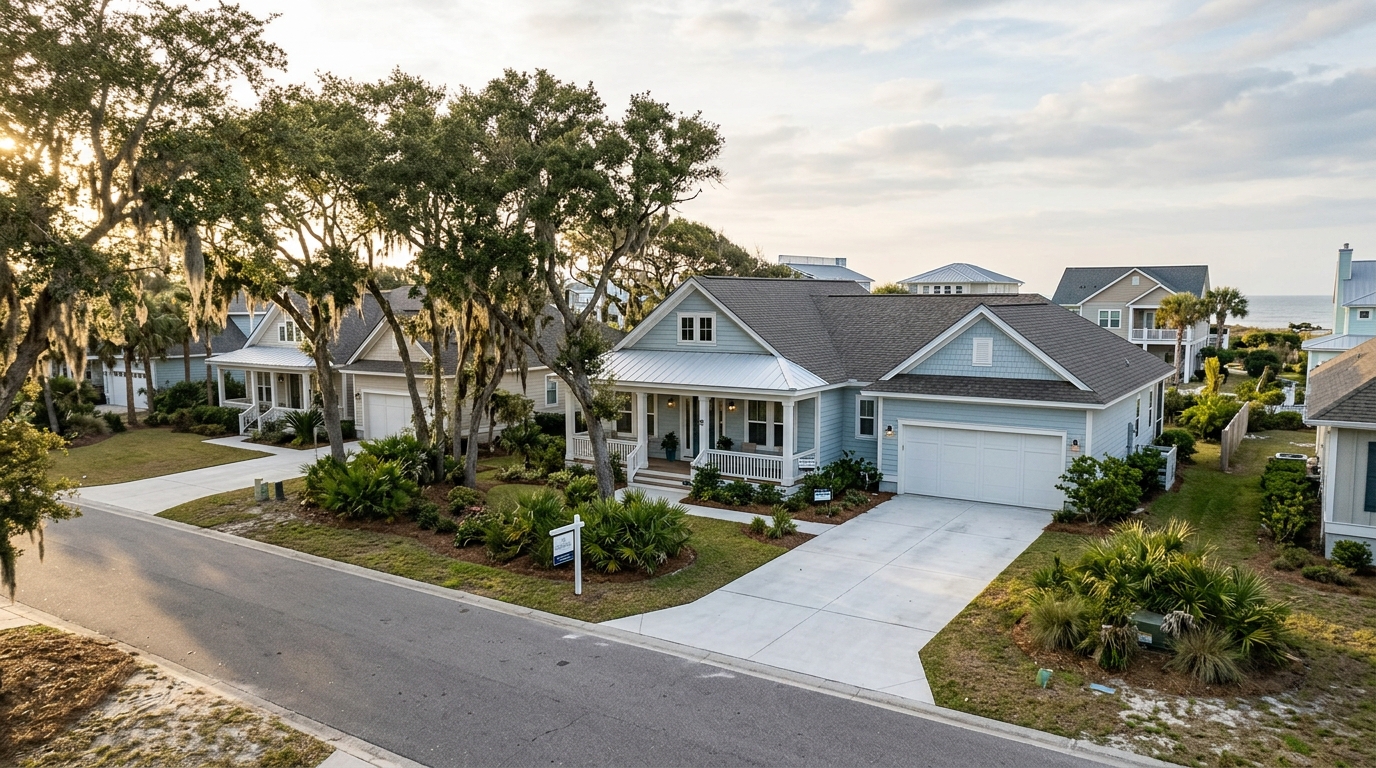
Moving up in or near Atlantic Beach means solving two problems at once: how to make a strong offer on the next home without being forced to carry two mortgages, and how to protect the Florida tax benefits you have already earned. The core decision is whether to make your purchase contingent on selling your current home or to use a bridge loan and buy first. A sale contingency lowers financial risk but weakens your offer; a bridge loan produces a cleaner, faster offer at higher cost. Timing also protects your Save Our Homes portability, which lets you transfer up to $500,000 of accumulated tax benefit to a qualifying new Florida homestead. Just know that your first Duval County bill on the higher-value home will reset to market value. With Atlantic Beach homes taking longer to sell than a year ago, the sell-time risk deserves real attention before you write an offer.
What is the honest starting question?
The honest starting question is how much timing pressure you can absorb. If you cannot comfortably carry two mortgages and you are buying in a market where sellers will accept conditions, a sale contingency is the sensible structure. If you have strong equity, solid credit, and you are competing for a specific home, a bridge loan lets you drop the contingency entirely.
Local sell-time is the input that tips the scale. Homes in Atlantic Beach sold after 88 days on the market on average, compared to 65 days a year earlier, according to Redfin's Atlantic Beach housing data (June 2025). Longer days-on-market raises the risk that a contingent purchase stalls or collapses because your departing home has not gone under contract in time. That same data notes the Atlantic Beach market is not very competitive, with multiple offers rare, so a well-priced contingent offer still has a real chance of being accepted here, unlike in a heated bidding market.
The neighborhood you are selling in matters too. A renovated home in Oceanwalk or a courtyard property in Atlantic Beach Country Club may attract interest faster than a dated listing farther from the water. Before you write a move-up offer, get a candid read on how quickly your specific home should move at its asking price. That estimate, more than any rule of thumb, tells you whether a contingency is safe.
How do a sale contingency and a bridge loan compare for a move-up buyer?
A sale contingency is a clause that makes your purchase conditional on your current home selling within a set window; it ties your closing to how fast your existing home goes under contract. A bridge loan is short-term financing that taps the equity in your current home so you can use it as a down payment on the next one before the first home sells. The two paths trade risk against competitiveness.
| Factor | Sale contingency | Bridge financing |
|---|---|---|
| Offer strength | Weaker; sellers may require a kick-out clause | Stronger; a clean, non-contingent offer |
| Financial risk | Lower; you buy only after your home sells | Higher; you may carry two homes briefly |
| Cost | Lower financing cost | Higher; origination, appraisal, title fees plus above-market interest |
| Best fit | Owners who cannot carry two homes | Owners with strong equity, credit, and reserves |
A bridge loan carries a higher interest rate than a standard mortgage and is meant for the short term, usually six to twelve months, so timing is critical. Lenders approve them based on combined loan-to-value limits, debt-to-income ratio, credit, reserves, and how marketable your current home is. In the current rate environment, that cost is not trivial: the 30-year fixed-rate mortgage averaged 6.58% as of July 23, 2026, up slightly from the prior week, per Freddie Mac's weekly survey.
The failure modes are different. With a contingency, the risk is losing the home you want if your sale runs long. With a bridge, the risk is carrying two payments if your departing home lingers. Possession strategies can soften both paths: a short leaseback to your buyer or flexible closing dates can buy you the days you need. If you want the deeper mechanics of buying first, this guide on buying a luxury home before selling your current one walks through the sequencing, and how jumbo loans work for Northeast Florida luxury homes is worth reading if your move-up price crosses conforming limits.
How much Save Our Homes tax benefit can I transfer to a higher-value home?
Save Our Homes portability lets you transfer up to $500,000 of accumulated property-tax benefit from a homesteaded Florida home to a qualifying new Florida homestead. The benefit is the gap between your old home's market value and its capped assessed value, built up over years because Save Our Homes limits annual assessment increases to 3%. Portability moves that gap with you instead of leaving it behind.
For a move-up buyer, the math is favorable. If you buy a home with an equal or higher just value, you can transfer your full benefit up to the $500,000 cap, according to the St. Johns County Property Appraiser. If you bought down to a lower-value home you would transfer only a proportionate share, but because move-up buyers purchase up, the full differential generally transfers. To qualify, you must hold a homestead exemption on your current residence, as the Jacksonville/Duval Property Appraiser explains.
The window matters. You can transfer your Save Our Homes benefit if you held the homestead exemption on your old home in any of the three tax roll years preceding the year you establish the new homestead. That three-year period, expanded from two years by 2020 Florida Amendment 5, gives you real breathing room to sell and buy without losing the transfer. Practically, you should establish your new homestead on or before January 1st of the third tax year after abandoning the old one. Coordinating your sale and purchase inside that window keeps the transfer clean regardless of which financing path you choose.
The exact portable amount depends on your specific parcel's accumulated differential. Pull your current home's record from the Duval County Property Appraiser to see your capped assessed value versus market value; the difference, up to $500,000, is what follows you. For a fuller walkthrough, see how the homestead exemption applies to Florida luxury homes.
Why will my first Duval County tax bill be higher than the prior owner's?
Your first tax bill on the move-up home resets to the property's market value because the seller's Save Our Homes protection does not transfer to you. On January 1st following a sale, the homestead exemption and the assessment cap are removed, and the assessed value rises to full market value for the new owner. A long-time owner may have paid tax on an assessed value far below what the home is actually worth; you start fresh at the purchase price.
This is the single most overlooked line in a move-up budget. Buyers see a seller's low current tax figure on a listing and assume they will pay something similar. They will not. Your portability benefit offsets part of the reset by lowering your new assessed value, and Duval's homestead exemption reduces it further; the county's total homestead exemption for 2026 is $51,411, up from $50,722 in 2025. Even so, plan for a higher annual bill than the prior owner carried.
If you are weighing a home across the county line, the tax math shifts. Ponte Vedra Beach sits in St. Johns County, while Atlantic Beach, Neptune Beach, and Jacksonville Beach are in Duval. The two counties apply different millage rates and services, so a comparison of Duval and St. Johns County property taxes is worth running before you commit to a neighborhood.
What capital gains and contract details should I settle before I list?
Settle three things before you list: your capital-gains exposure, whether your purchase contract protects your price, and how your two closings will be sequenced. The capital-gains question comes first because Atlantic Beach homes held for years can carry substantial appreciation.
A homeowner may exclude up to $250,000 of gain from the sale of a main home, or up to $500,000 for a married couple filing jointly, under IRS Topic 701. To qualify, you must have owned and used the home as your main home for at least two of the five years before the sale. Gain above the exclusion is taxable, so a long-held, highly appreciated beachfront property can generate a bill worth planning around. If the home you are selling is not your primary residence, review how capital gains work when selling a Florida second home, because the exclusion does not apply the same way.
On the purchase side, know what the standard Florida contract does and does not include. The core FloridaRealtors/Florida Bar contract does not contain an appraisal-to-price contingency by default; if you want the right to renegotiate or walk away when the appraisal comes in under contract price, you must add Comprehensive Rider F. On a move-up purchase financed with a mortgage, that rider is a meaningful protection you should ask for by name.
If you go the contingent route, understand the kick-out clause. A kick-out clause lets the seller keep marketing the home after accepting your contingent offer; if a stronger non-contingent offer arrives, the seller notifies you and you have a defined period, often 48 to 72 hours, to remove your contingency or release the home. It is common in a tight market and it means a contingent offer is never fully locked. When you list your own home, the approach to selling a luxury home in Atlantic Beach and the broader Northeast Florida luxury home buying process both feed into how aggressively you can afford to structure the purchase.