
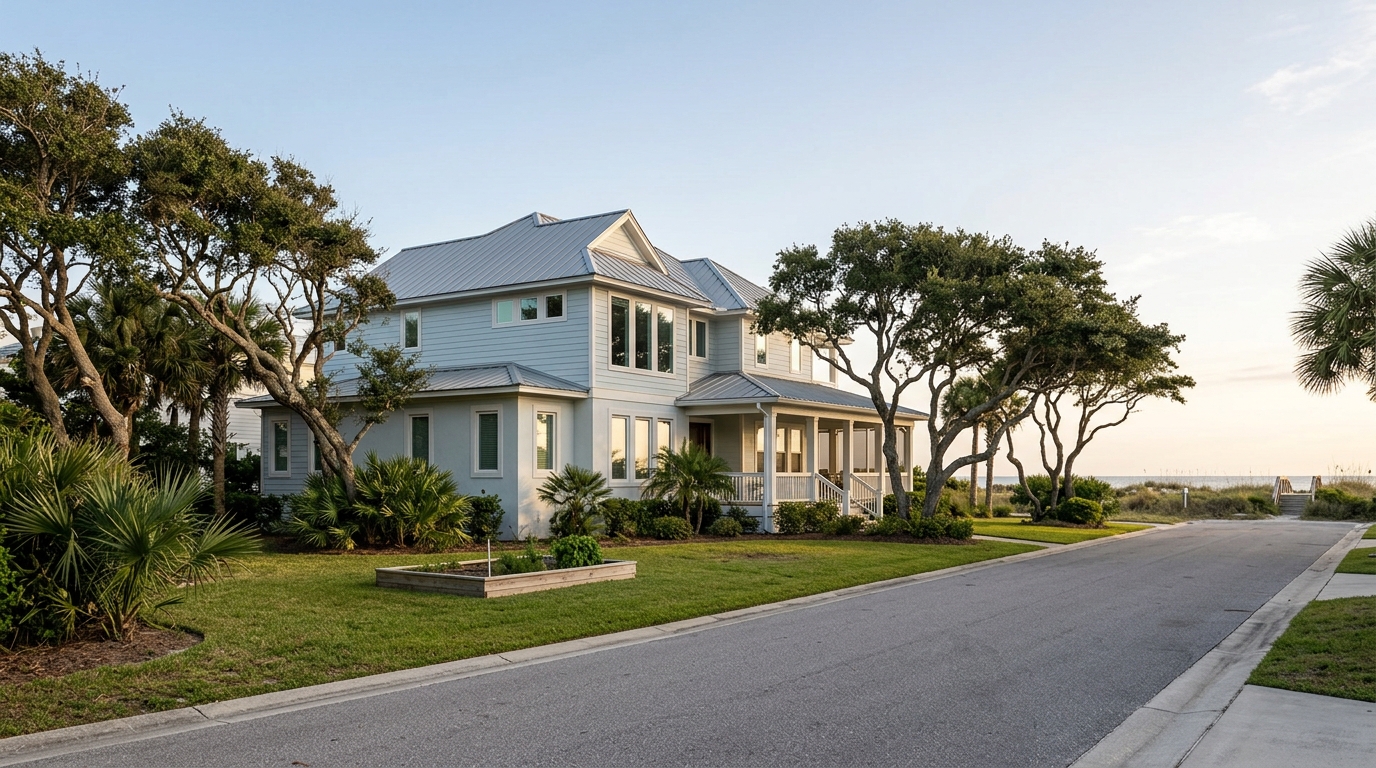
The true monthly cost of owning a home in Atlantic Beach runs well beyond the mortgage payment, and for a barrier-island purchase the gap is large. On a median-priced home near $812,000 (Krista Fracke/MLS, July 22, 2026), an illustrative year-one buyer with 20% down at a 6.58% 30-year fixed rate (Freddie Mac PMMS, week of July 23, 2026) lands around $5,858 to $6,238 a month once you stack property taxes, homeowners insurance, and flood coverage on top of principal and interest. That figure is a calculated illustration from cited component ranges, not a quote for any specific property. Five line items drive it: principal and interest, Duval County property taxes, HO-3 homeowners insurance, flood insurance, and HOA dues where they apply. Two of those, insurance and flood, are among the highest in the nation on a coastal parcel, which is why the sticker payment always understates the real number here.
What actually drives the monthly cost beyond the mortgage payment?
Five components make up the true monthly cost of an Atlantic Beach home, and only one of them is the mortgage. Principal and interest (P&I) is the amortizing loan payment, calculated on the financed amount at prevailing 30-year fixed rates. On the median-priced example above, P&I alone runs roughly $4,140 a month on a $649,600 loan at 6.58%. That is the number a national mortgage calculator shows, and it is the number that most understates coastal ownership.
The other four are property taxes, homeowners (wind/hazard) insurance, flood insurance, and HOA dues. Property taxes in Atlantic Beach are ad valorem levies set by Duval County taxing authorities in the district the Property Appraiser codes as USD3, the City of Atlantic Beach. Homeowners insurance is the HO-3 policy covering the structure and liability. Flood insurance is a separate NFIP or private policy, because a standard homeowners policy never covers flood damage. HOA dues apply only to specific subdivisions and condominiums.
Here is how those four non-mortgage lines translate to monthly dollars on the illustrative year-one purchase:
| Cost component | Illustrative monthly range | What determines your number |
|---|---|---|
| Property taxes | ~$1,106 | Purchase price and USD3 millage of 17.4153 |
| Homeowners insurance | $487, $700+ | Coastal proximity, roof age, wind mitigation |
| Flood insurance (AE zone) | $125, $292 | FEMA flood zone (X, AE, or VE) |
| HOA dues (where applicable) | ~$650 | Only ~21 of 70 active listings carry dues |
These ranges are calculated from cited component figures, not a single verified bill. The tax line comes from applying the 2024 Final Millage Chart to the median sold price; the insurance ranges reflect 2026 Florida averages weighted toward the coast.
Why does the seller's advertised tax number understate your year-one bill?
The seller's tax line on a listing almost always understates what you will pay, because of a homestead protection called Save Our Homes. Save Our Homes is a Florida constitutional cap that limits how much a homesteaded property's assessed value can rise each year to 3% or the change in CPI, whichever is lower (Save Our Homes). For 2025 the applied cap was 2.9%. A long-time owner has years of that protection holding their assessed value far below current market value, so their annual bill looks low.
When a homestead sells, that cap resets for the buyer. Your first-year assessed value equals just (market) value, which is essentially what you paid, and your own 3% cap begins accumulating from that higher base (PropertyTaxRates.org, April 28, 2026). The practical result is a first bill that is often materially higher than the seller's.
The math is straightforward. Using the median sold price of $812,000, the $50,000 homestead exemption, and the USD3 millage of 17.4153, the year-one tax works out to about $13,270 a year, or roughly $1,106 a month. That is a calculated figure; your actual bill depends on the assessment ratio and the applicable exemption, which rose to $51,411 for 2026, up from $50,722 in 2025 (Jacksonville Property Tax Guide, March 17, 2026).
For context on rates, Atlantic Beach's median effective property tax rate has been reported at 0.96%, below Florida's 1.10% median, yet the median tax bill of $5,503 still exceeds the national median of $2,400 (Ownwell, Duval County/Atlantic Beach dataset, 2026). Ownwell's own pages report a range between roughly 0.96% and 1.19% effective, so treat any single rate as a band rather than a point. If you are comparing the beaches, it is also worth understanding how Duval and St. Johns County property taxes differ, since Ponte Vedra Beach sits across the county line.
To claim homestead treatment you must occupy the property as your primary residence as of January 1 and apply by March 1. A vacation home or rental does not qualify and instead carries a 10% non-homestead assessment cap. You can read more about how property taxes work on Northeast Florida beach homes and the mechanics of the Florida homestead exemption on higher-value homes.
How do coastal insurance and flood zone exposure change the math?
Coastal insurance is the single line that pushes Atlantic Beach ownership costs toward the top of the national range, and flood zone is what determines whether that line is manageable or punishing. Florida's average homeowners premium hit $8,292 in 2025 and is projected at $8,458 by year-end 2026, roughly 2.8 times the U.S. average of $2,948 (Insurify, March 18, 2026). Other 2026 benchmarks put Florida's average between $5,500 and $11,000 depending on county and coastal proximity, and Atlantic Beach's oceanfront position pushes toward the higher end.
Two features of a Florida homeowners policy catch buyers off guard. First, hurricane deductibles typically run 2% to 10% of home value, so an owner absorbs the first $6,000 to $30,000 or more of wind damage before coverage kicks in (Wealthvieu, May 2026). Second, flood is never covered by homeowners insurance, which is why a separate policy is essential on the island.
Flood cost hinges entirely on your FEMA flood zone, and zones vary parcel to parcel across the barrier island. Zone X is lower risk with elective coverage. Zone AE is a high-risk Special Flood Hazard Area with an established base flood elevation. Zone VE is the most severe, covering coastal areas exposed to storm-wave action, with a 26% chance of flooding over the life of a 30-year mortgage (FEMA flood zone definitions, Bay County, FL).
| Flood zone | Typical annual flood premium | What it means for you |
|---|---|---|
| Zone X | $400, $800 | Lower risk; coverage is optional |
| Zone AE | $1,500, $3,500 | High-risk SFHA; mandatory if financed |
| Zone VE | $4,000, $10,000+ | Oceanfront wave hazard; can exceed $15,000 |
Zone AE and VE figures reflect Ben Laube Homes reporting (May 21, 2026). A financed buyer in any Special Flood Hazard Area cannot opt out of flood coverage. Before you fall for a home, confirm its designation through the FEMA flood zones covering Atlantic Beach and understand what flood insurance costs on Atlantic Beach oceanfront homes.
There is genuine relief on the horizon. For the first time since 2015, Citizens Property Insurance cut rates 8.7% statewide at Spring 2026 renewals, and 18 new private insurers have entered Florida since the 2022 reforms (CalcLogix, May 24, 2026). A wind mitigation inspection, which costs about $100 to $150, can save 20% to 45% on the windstorm portion of your premium. Because insurance now drives so much of a coastal payment, it also shapes value; here is more on how rising insurance costs affect beach home values.
How do you build an all-in monthly estimate you can actually verify?
Build your estimate from the four non-mortgage components plus P&I, using zone- and address-specific numbers rather than state averages. The illustrative all-in total for a year-one buyer on a $812,000 coastal AE parcel lands near $5,858 to $6,238 a month before HOA, PMI, and utilities: roughly $4,140 P&I, $1,106 taxes, $487 to $700 homeowners, and $125 to $292 flood. Treat that as a framework, not a quote.
To make it real, resolve three things for the specific property. First, get an actual insurance quote for the address, since Atlantic Beach premiums are not the same as statewide averages. Second, pull the FEMA flood-zone designation for the parcel, because AE and VE carry very different premiums. Third, model the tax reset off your purchase price, not the seller's line. A lender's Loan Estimate combined with bound insurance and flood quotes is the only way to produce a true, verified monthly figure.
Two budgeting mistakes cause the most payment surprises after closing. One is under-budgeting insurance escrow: in coastal counties, plan on $500 to $1,200 a month for insurance escrow, not $200. Florida escrow costs have jumped roughly 70% since 2019, the steepest in the nation, and about 65% of escrow accounts are projected to fall short, with an average shortage near $2,157 (CalcLogix citing Cotality/CNBC, May 2026). The second is using a statewide flood average on a high-risk parcel; if you are buying in AE or VE, that average badly understates your real cost.
HOA dues are a smaller and more selective factor. Most single-family Atlantic Beach listings carry no HOA, but about 21 of 70 active listings did, at roughly $650 a month as of July 2026 (Krista Fracke/MLS). Communities like Atlantic Beach Country Club and some Oceanwalk associations are where dues appear. For higher-value purchases, the financing decision itself changes the monthly math; here is more on weighing cash versus financing on a beach home and a fuller look at the hidden costs of buying a home in Atlantic Beach.
Frequently Asked Questions
Why is my first-year property tax bill higher than the seller's?
When a property sells, the county reassesses it at or near the purchase price, which resets the taxable value, often far above what the seller was paying under years of capped assessments. Florida's Save Our Homes cap limits annual increases for homesteaded owners to 3% or the rate of inflation, whichever is lower, but that protection does not carry over to a new buyer. Budget based on roughly 1% to 1.1% of your purchase price as a starting estimate for your first full tax year, not the seller's last bill.
How much should I budget monthly for insurance escrow on a coastal Atlantic Beach home?
Depending on the home's age, construction type, roof condition, and distance from the coast, annual premiums can range considerably, so a loan estimate from your lender will reflect the actual figure once a policy is bound. Treat insurance escrow as a variable line item, not a fixed one, because premiums can shift at each annual renewal.
Is flood insurance required on an Atlantic Beach home?
Whether flood insurance is required depends on which FEMA flood zone the specific property sits in, homes in high-risk Special Flood Hazard Areas (SFHAs) mapped as Zone AE or VE must carry flood insurance as a condition of any federally backed mortgage. Atlantic Beach has properties across multiple flood zone designations, so two houses on the same street can carry different requirements. Even when a lender does not require it, the financial exposure of going uninsured in a coastal community warrants a direct conversation with an insurance professional before you close.
Does the Save Our Homes cap transfer to me when I buy?
No, the Save Our Homes assessment cap belongs to the seller's homestead, not the property itself, and it terminates at the point of sale. As the new owner, you apply for your own homestead exemption (which reduces your assessed value by up to $50,000 for county and school taxing purposes), and your Save Our Homes cap begins building from that new assessed value going forward. The practical effect is that your first several years of ownership will not benefit from the decades of compounded cap savings the seller accumulated.
How much do HOA dues typically add to an Atlantic Beach monthly cost?
Atlantic Beach is largely a municipality of single-family neighborhoods, and many homes have no HOA at all, so the answer is zero for a substantial share of properties. Where an HOA does exist, dues vary based on what the association actually maintains: a community with a private road, common landscaping, or amenities will charge more than one that simply enforces architectural guidelines. Before making an offer on any HOA-governed property, review the current dues, the reserve fund status, and any pending special assessments, because those figures directly affect your true monthly carrying cost.